

Abstract
Hypnosis, which has been used for centuries in different forms, has to be re-evaluated in the light of modern medicine and science by biological, psychological, sociological and spiritual approaches. Hypnosis has been regaining its popularity in the trend of personalized and holistic medicine without any drug, injection or side effects.
Keywords: hypnosis, dissociation, absorption, fantasy proneness, imaginative capabilities, eye-movement techniques, expectancies, imaginative involvement, rapport, resonance
Definition
Hypnosis is an agreement of social interaction between a subject (designated as a patient) and the hypnotist (healthcare professional) who suggests imaginative experiences to change sensation, cognition, affect, mood, or behavior in perception, memory, and voluntary control of the action. Hypnosis promotes relaxation and enhances imagery to therapeutically recover forgotten incidents [1].
History of hypnosis
In mythology, Hypnos (Somnus, in Latin) is the personification of sleep who lived with his twin brother, Thanatos (Θάνατος, “death personified”) in a dark underworld cave on Lemnos island (according to Homer or Book XI of Ovid’s Metamorphoses) without any light from the sun or the moon; where flowed Lethe, the river of forgetfulness. His parents were Nyx (Νύξ, night) and Erebus (darkness), and he married with Pasithea, the goddess of marriage and birth and the deity of hallucination and relaxation. Their sons called Oneiroi (dreams) were bringers of dreams. Among them Morpheus brought human dreams; Icelus, animal dreams; and Phantasus, dreams of inanimate things. A bronze head of Hypnos is in British Museum in London (Figure 1). The English word “hypnosis” refers to a person put into a sleep-like state (hypnos “sleep” + −osis “condition”). Hypnosis was used in the temples of Aesculapius, the God of Medicine, where priests advised patients during their sleep as gods talking to them in their dreams. Etymologically speaking, Somnus, the Latin word for sleep, is the source of many English words such as insomnia (sleeplessness), somnolent (sleepy), hypersomnia (excessive sleep), and hypnotics(sleep-inducing drugs) among many others [3].

Figure 1.
Hypnos and thanatos carrying the body of sarpedon from the battlefield of Troy. Detail from an Attic white-ground lekythos, ca. 440 BC [2].
Mesmer, the founder of modern hypnosis, considered animal magnetism, an invisible magnetic fluid in all living things, as the cause of illness, which could be treated by manipulating with his hands through hypnosis (Figure 2). Although mesmerism was therapeutically effective, a scientific commission of inquiry attributed the effects of hypnosis to the imagination in France in 1784 [5].
The Marquis de Puységur, who experimented with animal magnetism, put a peasant, into a sleep-like state, a “sleep of senses,” after which he could not recall his responses to the suggestions during his sleep. A will to direct an organic power unites the magnetizer with the subject. Puységur actually evoked the latent capacity of the subject’s mental and emotional state by paying attention and showing a kind of benevolent love. This was the beginning of hypnosis. Puységur noted significant responses from his subject:

Figure 2.
Drawing room scene with many people sitting and standing around a large table; a man on a crutch has an iron band wrapped around his ankle; others in the group are holding bands similarly; to the left, a man has hypnotized a woman [4].
- sleep-waking state, that he called “magnetic sleep” or “magnetic somnambulism,” resembled a natural sleep-walking condition,
- rapport, a special connection with the magnetizer,
- suggestibility, heightened capacity to imagine vividly,
- amnesia in the waking state for the events that occurred in the state of magnetic sleep,
- ability to read the thoughts of the magnetizer, and diagnose the subject’s own illness,
- change in the personality of the magnetic subject, with increased alertness and self-confidence [6].
Freud also used hypnosis considering as hysterical reactions to traumatic experiences in childhood and mobilization of transference phenomena. Hypnotic techniques helped the soldiers to alleviate the effects of traumatic experiences during World War II and treat “traumatic neuroses” [7].
By the second half of the 19th century, Braid coined the term hypnotism and Erickson promoted new approaches to psychotherapy using hypnosis through storytelling [8].
Neurophysiology and hypnosis
Hypnotic modulation of suffering provokes changes in the anterior cingulate cortex, leaving the primary sensory cortex unaffected. Hypnotic modulation of color perception draining or adding color to a stimulus, real or hallucinated, activates the fusiform color area and the inferior temporal region of the cerebral cortex with clearer effects in the left cerebral hemisphere than in the right. The activation in the left fusiform area is only affected during hypnosis while the right fusiform activation is affected in both hypnotic and control conditions. fMRI (functional magnetic resonance imaging) shows heightened activity in the prefrontal cortex. The hypnotized people produce activity in the visual cortex to hallucinate an image. Hypnotic alteration of perception, involves top-down resetting of the intensity of perceptual response, rather than post perception processing changes. There is a decrease in the activity of the dorsal anterior cingulate (dACC) and an increase in connections between the dorsolateral prefrontal cortex and the insula connections between the dorsolateral prefrontal cortex and the default mode network including medial prefrontal and posterior cingulate cortex also weaken) [9, 10].
Hypnotizability is a stable trait and is assessed using scales based on the behavioral response of the person in a social context which is correlated with objective physiological responses. Brain activity and plasticity changes in hypnosis measured by functional magnetic resonance imaging (fMRI), positron emission tomography (PET) and electroencephalography (EEG) showed that hypnosis inhibits the reaction of the fear circuitry structures. Frontal and cingulate cortices are most linked to hypnotic responding [11].
Frontal functions have a central role in hypnotic responding. In the first phase of hypnosis, during the induction, the subject’s attention on an object stimulates fronto-limbic structures, which are inhibited and/or dissociated in the second phase. In the third phase, right-sided temporo-posterior regions are stimulated. In response to hypnosis, the fronto-cortical activity is reduced and the dorsolateral prefrontal cortex structures are dissociated and the cingulate activity increases or decreases depending on the suggestions. Hypnotic responding demonstrates greater dominance in the right hemisphere than left hemisphere processing, associated with cognitive activities while no difference is found in hypnotizability between left and right hemisphere lesions. Highs have significantly larger rostrum than lows. Hypnosis influences the connectivity between brain regions. The connectivity is decreased between frontal midline areas and left lateral scalp sites in highs while increased between left temporal and right occipital areas in lows. Areas and types of activity changes in the brain depend on the suggestions, rather than hypnosis per se. Highs are more prone to hypnotic suggestions by higher levels of theta activity and structural connectivity between left and right hemisphere frontal areas. Reducing frontal activity increases the response to hypnotic suggestions and not a general hypnotic responsivity [12–27].
Clinical applications
Hypnosis is performed to relieve pain in abdominal, breast, cardiac, genitourinary and orthopaedic surgery. Hypnosis is a powerful means of altering pain, anxiety, and various somatic functions and recovering forgotten incidents. Hypnosis is found efficient in cancer care even in bone cancer, leukaemia, and lymphoma specifically focused on treatment-induced and conditioned anticipatory nausea/vomiting, pain, anxiety/distress, and hot flashes to manage cancer-related pain, anxiety, fear, and lack of appetite. A potential method to manage side effects associated with cancer and cancer treatment.
Patients receiving local anaesthetic plus hypnosis experience less anticipatory procedure-related anxiety, and demonstrate less behavioral distress. Hypnosis-based interventions for cancer pain have significant pain reduction, especially when used in combination with other psychosocial-behavioral techniques and supportive-group therapy. Beneficial effects of hypnosis to treat anxiety and distress among cancer patients remained for at least 3 months’ post-intervention, without any adverse effect, relative to an educational intervention controlling the effects of time, therapist attention, and participation from pediatric to geriatric patients, among both sexes. Hypnosis delivered by a therapist is found more effective than self-hypnosis. Self-hypnosis training represents a rapid, cost-effective, nonaddictive, safe and efficacious treatment for anxiety prior to tests, surgery and medical procedures and anxiety-related disorders and psychological disorders such as stress, ego strengthening, unipolar depression, smoking cessation, weight loss, and rehabilitation. The hypnotic intervention is twice less expensive than the standard sedation procedure [28–32].
Hypnosis associated phenomena
5.1 Suggestion phenomena
Suggestibility,
Hypnotic suggestibility relies on different cognitive processes. Sensory Suggestibility requires the ability to imagine a non-existent, but suggested sensation. Methods that do not rely on trance, but heighten suggestibility are reflex conditioning, abstract conditioning, repetitive sensory stimulation, use of imagination, and misdirection of attention.
- primary suggestibility, direct suggestions for facilitation and inhibition of motor activity;
- secondary suggestibility, implied suggestions for sensory/perceptual changes;
- tertiary suggestibility, attitude changes in response to persuasive communications;
- interrogative suggestibility, occurs following misleading post-event information; or placebo response.
Posthypnotic suggestion: the subject takes the posthypnotic suggestion as a conscious act and continues responding to suggestions delivered in hypnosis even after the termination of hypnosis. The subject can receive and carry out posthypnotic suggestions. Periodic reinforcement makes the posthypnotic suggestions more effective because the behavior is experienced automatically without the involvement of executive awareness of this activity.
5.2 Ideosensory response phenomena
Hallucination: “hallucination” is a vivid visual ideosensory response, experiencing something that is not actually happening but feeling as if it was happening. Hallucination can be used for aversion therapy, to stop a habit such as smoking, nail-biting etc. The person can hallucinate any of the senses. When the subject perceives a specific object that is not actually present in the stimulus environment experience; it is called a positive ideosensory response and positive hallucination. If he/she fails to perceive a specific object that is present in the stimulus environment, it is called a negative ideosensory response and negative hallucination.
Anaesthesia is the reduction or loss of any sensory modality, such as blindness, deafness, anosmia, analgesia, or tactile anaesthesia. Self-generated pain control can be recreated using hypnotic suggestions for various conditions such as headache and dystonia. Surgery can be performed using only hypnotic anaesthesia for pain management without any drug. Not everybody can achieve the depth of trance required for surgical work, but they can become suggestible enough to produce numbness in the hand referred to as “glove anaesthesia,” then “transferred” by touch wherever needed. Numbness of any part of the body can occur spontaneously so profoundly that needles can be inserted into the body without discomfort. If the hypnotist tells the subject to reduce its perception through the sensation of tingling and numbness, with decreased activity of somatosensory dorsal anterior cingulate cortex (dACC). Hypno-analgesia cannot be reversed by naloxone, an opiate receptor blocker.
5.3 Ideomotor phenomena
Ideomotor responses refer to motor phenomena of muscles responding instantaneously to thoughts and feelings, a movement in response to an idea. The subject moves in response to a suggestion given during hypnosis.
Catalepsy: involuntary tonicity, rigidity or immobility of muscles. It can happen naturally in a fight, flight or freeze state where the body is stuck in place even though the mind tells it to move. It can be used in the induction/deepening process (with an eye catalepsy/eye lock test) during eyeball catalepsy. Psychogenic sexual issues such as erectile dysfunction or insomniacs who move around too much in their sleep can be relieved by hypnotic catalepsy.
Automatic Writing: “Doodling” is the manifestation of automatic writing and answering to completely different questions without any conscious effort while talking or listening. Then, the subject can interpret what was written in hypnosis.
5.4 Memory phenomena
The hypnotic state of the brain activity is a sort of functional amnesia, a reversible dissociation between implicit and explicit memory (post hypnotic amnesia (PHA)).
Amnesia refers to the act of forgetting. Spontaneously occurred amnesia indicates a deep state of hypnosis known as somnambulism. Amnesia is a temporary result of specific hypnotic suggestions.
Somnambulism: deep stage of hypnosis like sleepwalkers’ experience. Hypnotic suggestions become automatic convictions which cannot be recollected by the subject. The hypnotized subject obeys to the directions as awake.
Posthypnotic amnesia, the subject cannot remember events and experiences that he/she lived during hypnosis.
False memory syndrome: Events are processed by the physical brain to become memories accessible by the non-physical mind. A false belief in the mind of another can be instilled.
Cryptomnesia is responsible for past life regression episodes. Invisibly stored information within the brain can be recalled as a result of a stimulus.
Repression: Profound guilt or vulnerability to shame, hate, or death, causes to “hide” the event in a time capsule in the mind so that consciousness is no longer aware of the vulnerability. Repressed memories can lay dormant for years doing nothing for the owner. The conscious mind uses rationalization, as a logical reason for the symptoms associated with the reminiscent event of the original trauma. Repression, a function of the mind’s capacity can be triggered by anything within human experience connected to the repressed memory in forming new instinctive behavior patterns relevant to the living environment. Hypnoanalysis resistance means aborting therapy because of a threat to security felt by the subject. The memory is composed of three separate parts– event, physiological reaction, and emotional response. Any one or all three can be repressed.
Hypermnesia (Memory Recall): Experiencing heightened recall abilities during hypnosis is known as hypermnesia. It is the act of remembering more than normal (enhanced recall). Since the material can be inaccurate or false, hypnotically recovered memories are not allowed as “evidence” in court cases. The main use for the phenomena of hypermnesia assists in finding lost items and discovering their locations by remembering past events to attain further details. The hypnotherapist will ask the subject to let the mind drift to the last time that he/she saw the item or places to be with it or handling it and to remember and say as much about the item.
Regression: the subject just imagines vividly going back to a past event and being aware that he/she is not actually there. It is used for phobias that have started during childhood.
Age Regression (Pseudo revivification): The subject relives previous life experiences as if they happened in present. The subject goes to earlier experiences related to the current problem in the present existence.
Pseudo-regression: Instead of identifying the experiences directly, the subject observes the event from another view as if on a television or movie screen.
Revivification: reliving an incident in the present tense as if the subject was there at that time without current knowledge. Revivification requires a deeper state of hypnosis and responsiveness to suggestions and can be experienced in the night dreams. Some regress while some others revivify.
Retrogression (Dynamic Regression): Retrogression is a spontaneous age regression with revivification mixed in.
Age Progression: The subject feels living in the future even though remains in the present age. Age progression is a means to predict how a person would react to an event in the future.
5.5 Perception phenomena
Dissociation: to disintegrate the subject from the painful part of the body to get rid of past traumatic events against fears and phobias. The subject would imagine negative situations. It is like watching a memory on a TV screen rather than seeing through the eyes. The dissociation reduces the emotional responses of the subject who would go to a happy place to dissociate from what happens here and now.
Depersonalization: The subject ignores his/her own identity, and acts as another person from a new perspective.
Time distortion: The subjective measuring of time can be altered simply by either enjoying or waiting for something in hypnosis. A person feels the expansion of time in boredom. Contraction is the opposite like time flying while having fun. For example, a nervous aeroplane passenger can start to believe to be on the plane for less time or extend the perceived time of someone on a diet.
Future pacing (mental rehearsal): It is a kind of visualization where the subject can prepare himself/herself for success and realization of his/her goals by overcoming the potential obstacles through future options [33–35].
Theories
A comprehensive theory of hypnosis should cover both cognitive and interpersonal terms. Throughout the twentieth century, the theories about hypnosis have been between “state” vs. “non-state” theories.
6.1 State theories
Hilgard’s Neodissociation Theory entails a division in consciousness.
6.1.1 Dissociated control theory (DCT)
DCT claims that normally driving habitual behaviors can be influenced outside of conscious awareness without executive control. According to Ego-state theorists, clinicians can promote behavioral change by hypnosis, and have conversations with different ego states.
6.1.2 Dissociated-experience theory
High hypnotizables respond voluntarily dissociated from conscious awareness. The school of Gerald Brassine of Belgium has considered hypnosis not only a question of words nor the result of suggestion, but the product of the use of imagery or memories of the person, having a lot of implicit consequences and practical attitudes in the practice and being a natural product of many different things including choc (trauma) days dreaming and psychotherapeutic hypnosis. The hypnotic relationship would develop more easily if the therapist demonstrates that the patient is the only “ producer” of this state. In such an equal relationship, the hypnotist becomes a facilitator helping the patient to develop a state of trance, but he/she can reject or come out of it anytime if he/she does not want. This comprehension would facilitate a deep state of hypnosis during which the patient feels like “ the boss” of the hypnotic situation, in which he/she does not lose but gains control of his/her emotions and sensations in his/her autonomous nervous system (a psychosomatic control over extremely painful diseases) with the help or assistance of the hypnotist in a cooperative venture. If the therapist understands and acts on this principle at all times, and explains and offers to the patient the knowledge that he/she can produce this phenomenon, the patient would be much more eager to try the proposed possibilities (all classical hypnotic phenomena) and this type of therapist would be much more efficient than any other who just believes that his/her speaking (use of the word) and techniques are responsible for the trance of the patient. (It is not far from the Mesmerian conception of animal magnetism or later hypnosis considered as the fruit of the genius suggestions of a therapist). In practice, the emphasis should be on what the patient does and says and not what the therapist says and does.
In the school of Gerald Brassine of Belgium, the thought and practice of PTR (Psychotherapie du Trauma Réassociative) is willing to bring the patient in a state of hypnosis by using what is called utilizational hypnosis. It means that the therapist eases the patient to develop and use a trance state in a constant exchange. This comprehension or conceptualization of hypnosis (the result of the use of memory or imaginative capacities) is building an equalitarian form of relationship in which the patient controls his/her sensations and emotions and the therapist supports and indicates to the patient the possibilities of work while keeping in mind that the patient might probably have better ideas on how to solve his/her difficulties. This is called the production of PAAT (in French: Processus Autonomes Auto-Therapeutiques (more or less in English: Autonomous (Self?) Auto-therapeutic Processes).
Another idea could be the use of the protective dissociations in a concept that implies that the natural apparition of hypnotic phenomena during traumas can be fixed as dissociative reactions turned into symptoms, which can be paradoxically utilized by the therapist to facilitate their eradication as “mental or psychic anaesthetics.” Directly derived from the concept that hypnosis is not a result of suggestion, this method brings an incredible opportunity to treat the patients rapidly and comfortably in the situation of extreme suffering and in the treatment of psychosomatic diseases [36].
6.1.3 Gruzelier’s neurophysiological theory
High and low hypnotizables are characterized by changes in brain function.
6.2 Non-state theories
6.2.1 Spanos’ socio-cognitive theory
Hypnosis is not an altered state of consciousness. Attitudes, beliefs, imaginings, attributions and expectancies form hypnotic experiences and outcomes depending on the interpretation of the suggestions without active planning and effort. The sociocognitive behavioral model is used together with contemporary cognitive-behavioral psychotherapies focusing on the effects of thoughts, beliefs, and imaginings on behavior and emotion.
6.2.2 Kirsch’s response expectancy theory
Proposes that subjects have generalized response expectancy in a hypnotic situation and follow the hypnotists’ instructions and experience involuntary behaviors attributable to external causes (the hypnotist). Two social factors associated with response to hypnosis: rapport (“therapeutic alliance,” “resonance,” and “harmony,”) and social context are taken into account.
6.3 Integrative/middle-way/neither-one-nor-the-other theories
Cold control theory proposes that the central feature of hypnotic responding is the involuntariness in actual intentional action.
6.3.1 Brown and Oakley’s integrative cognitive theory
Proposes that involuntariness is an attribute to the causes of behavior and suggestions.
An ability-aptitude model considers two factors as the influencing cause of hypnotic response:
- a latent cognitive ability for hypnotic response
- the subject’s beliefs about his/her hypnotic response
| State theories | Non-state theories |
| Hypnotic inductions produce an altered state of consciousness | Participants respond to suggestions almost as well without hypnosis |
| Hypnotic “trance” is associated with an altered state of brain function | Participants in hypnosis experiments are actively engaged |
| Responses to hypnotic suggestions are a result of special processes such as dissociation or other altered states of consciousness | Responses to suggestions are a product of normal psychological processes such as attitudes, expectancies, and motivation |
| Hypnotizability is remarkably stable over long periods | Suggestibility can be modified with drugs or psychological procedures |
Table 1.
State and non-state theories [37].
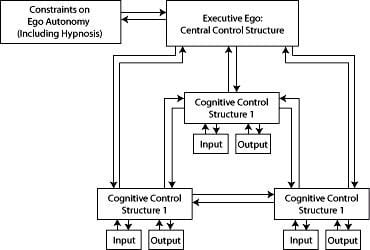
Table 2.
Illustration of Hilgard’s neodissociation theory of hypnosis [38].
The social-psychobiological or biopsychosocial model of hypnosis emphasizes the interaction of the hypnotist and the subject, considering their personal characteristics and physiological mechanisms and the contributing role of biological, psychological, and social factors. Hypnotic depth integrates the behavioral aspect (the role of the subject), the phenomenological component (the subjective feeling of trance), and an emotional dimension.
The empathic involvement theory (EIT) of hypnosis proposes a bridging of two incongruent neo dissociative versus socio-cognitive theories of hypnosis. Non-empathic individuals benefit less from hypnosis (Tables 1–3) [39–42].
Scales
Standardized psychological tests such as the Stanford Hypnotic Susceptibility Scale or the Harvard Group Scale of Hypnotic Susceptibility (SHSS) measure hypnotizability. The Stanford Profile Scales of Hypnotic Susceptibility (SPSHS), in two forms (I and II), evaluate individual strengths and weaknesses. On the individually administered Stanford Scales, each of 12 test suggestions, scored pass-fail, yield a sum score of hypnotizability on a 0-12 scale. The Stanford Hypnotic Susceptibility Scale, Form C (SHSS:C), that contains cognitive suggestions including hallucination and age regression, is the gold standard for measuring hypnotizability.
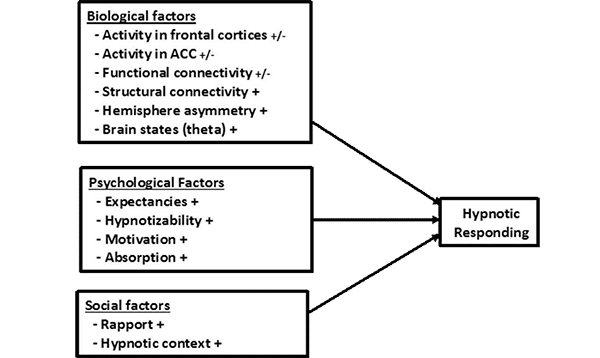
Table 3.
Summary of the state of the scientific findings regarding biological, psychological and social factors that contribute to the response to hypnosis and hypnotic suggestions. +/− indicates that the factor has demonstrated both positive and negative associations with hypnotic responding: + indicates that the factor has demonstrated mostly positive and consistent associations [43].
The SWASH (Sussex-Waterloo Scale of Hypnotizability) is a 10-item modified Waterloo-Stanford Group C Scale of Hypnotic Suggestibility (WSGC) to reduce screening time and supplement objective scoring. It measures capacity and alters the conscious experience. The Dissociative Experiences Scale, a 28-item scale, assesses dissociative experiences. The Tellegen Absorption Scale, a 34-item questionnaire evaluates the capacity of absorption. The Dyadic Interactional Harmony Questionnaire (DIH) assesses four domains of hypnotist-subject interaction: intimacy, communion, playfulness, and tension. Valencia Scale of Attitudes and Beliefs Toward
The hypnosis scale (VSABTH) considers two reliable measures of attitudes, response expectancies and emotional distress toward hypnosis as mediator of hypnotic effects. PCI-HAP (Phenomenology of Consciousness: Inventory-Hypnotic Assessment Procedure) set out to predict hypnotic depth scores [44–46].
Mechanism
The process of hypnosis consists of hypnotic induction, a deepening procedure, and symptom-specific suggestions. Hypnosis is a state of highly focused attention, with dissociation of thoughts and sensations toward awareness. It is comprised of three components: absorption, dissociation, and suggestibility. Absorption is full involvement in a perceptual, imaginative or ideational experience for self-altering attention. Dissociation is the mental segregation of components of behavior in a dream-like state of being both actor and observer when re-experiencing autobiographical memories in involuntary motor functions or discontinuities in the sensations of one part of the body compared with another. Suggestibility complies with hypnotic instructions. It is not a loss of will but rather a suspension of judgment due to the absorption and effortless self-loss in what is concentrated on. The hypnotized person does not have control over his/her thoughts and actions and follows the suggestions without looking for alternatives and analysing their context. The principle of hypnosis is to recall traumatic memories and manage their associated effect and physiological responses by reevaluating their meaning from a new perspective. Hypnosis is a set of techniques to fortify concentration, by decreasing the effect of distractions and increasing to change the subject’s s thoughts, feelings, behavior, or physiological state. Hypnosis is not psychotherapy. Hypnotic perceptual and cognitive changes the equilibrium between suggestion, expectation, and task instructions [47–49].
A new non-pharmacological technique called virtual reality hypnosis (VRH), combines VR hardware/software and hypnotic induction. In hypnosis, the subject constitutes his own world by the hypnotist’s suggestions through absorption and dissociation. Virtual reality hypnosis (VRH) does not depend upon the skill of the hypnotist and the openness of the subject. The subjects need less imagination and absorption due to visual and auditory stimuli presented in virtual reality [50–52].
Five psychological factors are most important for the success of hypnosis: hypnotizability, expectancies, motivation, absorptive capacity/fantasy proneness, and attitudes toward hypnosis. The specific type and wording of suggestions influence the outcome. Expectancies determine the extent how much the subject believes in the experience and response to the hypnotic intervention. Past experience, current context, and interaction influence expectancies. The collaborative and affective bond between the hypnotist and the subject is the essential component of hypnosis. The subject’s positive response to the contradictory suggestions to his/her previous perception is called countering. Hypnosis is a change in baseline mental activity. Hypnosis like practices inducing trance states has been used throughout history. Medical hypnosis is applying hypnosis to alleviate somatic symptoms, reduce stress, and influence physiological/biochemical processes. The interactional behavioral and affective synchrony between the child and the parent is highly similar to the relationship between the subject and the hypnotist. Synchrony can occur in the behavioral, emotional, phenomenological, and psycho-physiological variables in both the subject and the hypnotist [53–59].
In the psychoanalytic approach to hypnosis, the hypnotist is similar to an authority figure of the subject from his earlier life experience. Frequently punished children would try not to displease the hypnotist and would show a high level of dissociation. Negative parental behavior (punishment and over-protection) is related to the phenomenological and emotional dimensions of hypnotic response leading to higher hypnotizability. The parental behavior of the subject influences hypnotic behavior, experiences, and emotional bond with the hypnotist. A warm- supportive parental style provokes more positive feelings toward the hypnotist, whereas cold-punishing parental behavior is correlated to negative feelings about the hypnotist and hypnosis itself. One consistent pattern in females is that maternal punishment predicts only negative effects in hypnosis, while punishing parental behavior in men, predicts both positive and negative responses to hypnosis. Alexithymia, the decreased ability to identify and verbalize someone’s own emotions, mediates between parental punishment and fear in hypnosis. Therefore, hypnotherapist should search before the hypnotherapeutic intervention for the subject’s memories of their parents, which will influence his/her expectations about hypnosis and the hypnotist. Subjects remembering punishing, and/or emotionally unresponsive parents would stay away from the hypnotist even if they know that hypnotherapy would correct the source of the problem. They may feel stress and anxiety in the hypnotic state which can be regulated by a sense of security and mutual trust [60–63].
Mindfulness meditation and hypnosis remain opposing ways to awareness of intentions. Hypnosis and meditation may be combined as a psychosomatic technique to control mind and body regulation. The phenomenology and neuropsychology of hypnosis and meditation follow common features:
- focused attention is the base of induction
- intentional control of biologic-somatic activities
- activation/deactivation of the default modality network and pain neuromatrix [64, 65].
The “mirror neurons” in the human brain provide empathy to sense the intentions of others by observing their behaviour and related brain activity. They function as a rapport zone mediating between observing consciousness, the gene expression/ protein synthesis cycle, and brain plasticity in hypnotherapy and psychosomatic medicine. (Emerging science recognizes human experience not as a disease but as manifestations of the individual adaptive self-regulating system) [66].
Tandem hypnotherapy considers the unity of body and mind as a quantum process, from the embryonic period of life. Tandem has two meanings: (1) a multi-seater bicycle, (2) a mosaic word: Touch of Ancient and New generations with a Dialog Experiencing Oneness of Minds (TANDEM). Hypnotherapy, psychodrama, family therapy, Hellinger’s systemic-phenomenological approach, and holding therapy are united in the Tandem theory. More than two persons in a physical closeness touching each other take part in therapy: (1) patient(s), (2) one or more co-therapists or antagonists in psychodrama. The therapist takes the responsibility for the tandem of the patient(s) and co-therapist(s). Sensory-motor level of development originated from the fetal period of life. In uniting mode of experiencing, object and subject are not seen as different from each other. The most effective stimulus is physical closeness and touching in an intimate situation as a form of body psychotherapy. The psychological factors for hypnosis are hypnotizability, expectations, motivation, absorption/imaginative involvement/fantasy proneness, attitudes toward hypnosis, and rapport as social factors lead to “resonance” and “harmony” [67, 68].
Hypnosis and hypnotherapy, which have been experienced for centuries, emerged as a new solitary or complementary approach based on science for the wellness of people.
Author Details
Cengiz Mordeniz
Tekirdag Namik Kemal University, Turkey
*Address all correspondence to: cengizmorster@gmail.com
This is distributed under the terms of the Creative Commons Attribution License, which permits unrestricted use, distribution, and reproduction in any medium provided the original work is properly cited.
References
[1] Kihlstrom, J. F. Hypnosis and the Psychological Unconscious, Editor(s): Howard S. Friedman, Assessment and Therapy, Academic Press, 2001, Pages 215-225, ISBN 9780122678066
[2] https://archive.org/details/historyancientp12bircgoog/page/n1/mode/2up
[3] https://www.greekmythology.com/ Other_Gods/Hypnos/hypnos.html
[4] https://harvardmagazine.com/2003/11/hypnosis-heals.html
[5] Hammond DC. A review of the history of hypnosis through the late 19th century. Am J Clin Hypn. 2013;56:174-91. https://doi.org/10.1080/00029157.2013.826172
[6] Crabtree A. 1784: The Marquis de Puységur and the psychological turn in the west. J Hist Behav Sci. 2019;55:199-215. DOI: 10.1002/jhbs.21974
[7] Kluft R.P. (2018) Reconsidering Hypnosis and Psychoanalysis: Toward Creating a Context for Understanding, American Journal of Clinical Hypnosis, 60:3, 201-215, DOI:10.1080/00029157.2018.1400810
[8] Winter, A. (2000). Mesmerized: Powers of mind in Victorian Britain. Chicago, IL: University of Chicago Press.
[9] Vanhaudenhuyse, S. Laureys, M.-E. Faymonville. Neurophysiology of hypnosis. Neurophysiologie Clinique/Clinical Neurophysiology,Volume 44, Issue 4,2014, Pages 343-353.
[10] Hoeft, F., Gabrieli, J. D., Whitfield-Gabrieli, S., Haas, B.W., Bammer, R., Menon, V., & Spiegel, D. (2012). Functional brain basis of hypnotizability. Archives of general psychiatry, 69(10), 1064-1072. https://doi.org/10.1001/archgenpsychiatry.2011.2190
[11] Spiegel D, Tranceformations: Hypnosis In Brain And Body Depression And Anxiety 30:342-352 (2013)
[12] Gruzelier JH. Frontal functions, connectivity and neural efficiency underpinning hypnosis and hypnotic susceptibility. Contemporary Hypnosis. 2006;23:15-32.
[13] Dienes Z, Hutton S. Understanding hypnosis metacognitively: rTMS applied to left DLPFC increases hypnotic suggestibility. Cortex. 2013;49(2):386-392.
[14] Kihlstrom JF. Neurohypnotism: prospects for hypnosis and neuroscience. Cortex. 2013;49(2):365-374.
[15] Oakley DA, Halligan PW. Psychophysiological foundations of hypnosis and suggestion. In: Lynn SJ, Rhue JW, Kirsch I, editors. Handbook of clinical hypnosis. 2nd ed. Washington, DC: American Psychological Association; 2010. pp. 79-117
[16] Cardeña E, Jonsson P, Terhune DB, Marcusson-Clavertz D. The neurophenomenology of neutral hypnosis. Cortex. 2013;49(2):375-385
[17] Egner T, Jamieson G, Gruzelier J. Hypnosis decouples cognitive control from conflict monitoring processes of the frontal lobe. Neuroimage. 2005;27(4):969-978.
[18] Fingelkurts AA, Kallio S, Revonsuo A. Cortex functional connectivity as a neurophysiological correlate of hypnosis: an EEG case study. Neuropsychologia. 2007;45(7):1452-1462
[19] Pyka M, Burgmer M, Lenzen T, Pioch R, Dannlowski U, Pfleiderer B, Ewert AW, Konrad C. Brain correlates of hypnotic paralysis—a resting-state fMRI study. Neuroimage. 2011;56:2173-2182
[20] Horton JE, Crawford HJ, Harrington G, Downs JH., 3rd Increased anterior corpus callosum size associated positively with hypnotizability and the ability to control pain. Brain. 2004;127(Pt 8):1741-1747
[21] Moretti D.V. Theta and alpha EEG frequency interplay in subjects with mild cognitive impairment: evidence from EEG, MRI, and SPECT brain modifications, Frontiers in Aging Neuroscience, 7, p. 31 (2015). 10.3389/fnagi.2015.00031
[22] Terhune D.B., Cardeña E. & Lindgren M. Differential frontalparietal phase synchrony during hypnosis as a function of hypnotic suggestibility Psychophysiology 48, pp. 1444-1447 (2011). 10.1111/j.1469-8986.2011.01211.x
[23] Jamieson G.A. & Burgess A.P. Hypnotic induction is followed by state-like changes in the organization of EEG functional connectivity in the theta and beta frequency bands in high-hypnotically susceptible individuals, Frontiers in Human Neuroscience, 8 (2014).
[24] Deivanayagi S., Manivannan M. & Fernandez P., Spectral analysis of EEG signals during hypnosis, International Journal of Systemics, Cybernetics and Informatics, 4, pp. 75-80 (2007).
[25] Jensen MP. Hypnosis for chronic pain management: Therapist guide. Oxford: Oxford University Press; 2011.
[26] Palsson OS. Hypnosis treatment of gastrointestinal disorders: a comprehensive review of the empirical evidence. Am J Clin Hypn. 2015;58:134-58.
[27] Cramer H, Lauche R, Paul A, Langhorst J, Kümmel S, Dobos GJ. Hypnosis in breast cancer care: a systematic review of randomized controlled trials. Integr Cancer Ther. 2015;14:5-15. https://doi.org/10.1177/1534735414550035
[28] Lisa A. Osborne & Phil Reed (2019) A Review of Hypnotherapy for Overactive Bladder, International Journal of Clinical and Experimental Hypnosis, 67:3, 278-296, DOI: 10.1080/00207144.2019.1612671
[29] Caldwell PHY, Codarini M, Stewart F, Hahn D, Sureshkumar P. Alarm interventions for nocturnal enuresis in children. Cochrane Database of Systematic Reviews 2020, Issue 5.Art.No.: CD002911. DOI: 10.1002/14651858.CD002911.pub3.
[30] Rutten JM, Reitsma JB, Vlieger AM, Benninga MA. Gut-directed hypnotherapy for functional abdominal pain or irritable bowel syndrome in children: a systematic review. Arch Dis Child. 2013;98(4):252-257.
[31] Golden WL. Cognitive hypnotherapy for anxiety disorders. American Journal of Clinical Hypnosis. 2012;54(4):263-274
[32] Assen A. (2012) Cognitive Hypnotherapy for Major Depressive Disorder, American Journal of Clinical Hypnosis, 54:4, 275-293, DOI:10.1080/00029157.2012.654527
[33] http://johnmongiovi.com/blog/2014/12/01/hypnosis-and-memory
[34] https://www.selfhypnosis.com/hypnotic-phenomena/
[35] http://johnmongiovi.com/blog/2015/09/10/phenomena-of-hypnosis
[36] Brassine G. (2019 ). Protections dissociatives anesthésiants pour l’hypnothérapie du trauma. Hypnose & therapies breves n° 55:18-26.
[37] Jensen, M. P., Adachi, T., Tomé-Pires, C., Lee, J., Osman, Z. J., & Miró, J. (2015). Mechanisms of hypnosis: toward the development of a biopsychosocial model. The International journal of clinical and experimental hypnosis, 63(1), 34-75. https://doi.org/10.1080/00207144.2014.961875
[38] Woody, E. Z., Sadler, P. (2008). Dissociation theories of hypnosis. In M.R. Nash & A. J. Barnier (eds). The Oxford Handbook of Hypnosis: Theory, Research and Practice. Oxford: Oxford University Press.
[39] Sadler, P., & Woody, E. Z. (2010). Dissociation in hypnosis: Theoretical frameworks and psychotherapeutic implications (PDF). In J. W. Rhue, S. J. Lynn, & I. Kirsch (Eds.), Handbook of clinical hypnosis (2nd ed.) (pp.151-268). Washington, DC: American Psychological Association.
[40] Lynn, S. J., & Kirsch, I. (2006). Essentials of clinical hypnosis: An evidence-based approach. Washington, DC: American Psychological Association.
[41] Schotte CK, Van Den Bossche B, De Doncker D, Claes S, Cosyns P. A biopsychosocial model as a guide for psychoeducation and treatment of depression. Depress Anxiety. 2006;23(5):312-324
[42] Buckner JD, Heimberg RG, Ecker AH, Vinci C. A biopsychosocial model of social anxiety and substance use. Depression and Anxiety. 2013;30(3):276-284
[43] https://hypnosisandsuggestion.org/
[44] Pam. Stanford Hypnotic Susceptibility Scale, in Psychology Dictionary.org, https://psychologydictionary.org/stanford-hypnotic-susceptibility-scale/
[45] P Lush, G Moga, N McLatchie, Z Dienes, The Sussex-Waterloo Scale of Hypnotizability (SWASH): measuring capacity for altering conscious experience, Neuroscience of Consciousness, Volume 2018, Issue 1, 2018, niy006, https://doi.org/10.1093/nc/niy006
[46] Anlló H, Becchio J, Sackur J. French norms for the Harvard Group Scale of Hypnotic Susceptibility, form A. Int J Clin Exp Hypn 2017;65:241-55
[47] Priftis K, Schiff S, Tikhonoff V et al. Hypnosis meets neuropsychology: simulating visuospatial neglect in healthy participants. Neuropsychologia 2011;49:3346-50
[48] Mallard D, Bryant R. Hypnotic conflict: a brief report. Int J Clin Exp Hypn 2006;54:292-302.
[49] Landry M, Apporchaux K, Raz A. Elucidating unconscious processing with instrumental hypnosis. Front Psychol 2014;5:785
[50] Rousseaux, F., Faymonville, M. E., Nyssen, A. S., Dardenne, N., Ledoux, D., Massion, P. B., & Vanhaudenhuyse, A. (2020). Can hypnosis and virtual reality reduce anxiety, pain and fatigue among patients who undergo cardiac surgery: a randomised controlled trial. Trials, 21(1), 330. https://doi.org/10.1186/s13063-020-4222-6
[51] Enea V, Dafinoiu I, Opriş D, David D. Effects of hypnotic analgesia and virtual reality on the reduction of experimental pain among high and low hypnotizables. Int J Clin Exp Hypn. 2014; 62(3):360-77.
[52] Patterson DR, Jensen MP, Wiechman SA, Sharar SR. Virtual reality hypnosis for pain associated with recovery from physical trauma. Int J Clin Exp Hypn. 2010 Jul; 58(3):288-300.
[53] //doi.org/10.1080/00207144.2014.961875
[54] Wagstaff GF, David D, Kirsch I, Lynn SJ. The cognitive-behavioral model of hypnotherapy. In: Lynn SJ, Rhue JW, Kirsch I, editors. Handbook of clinical hypnosis. 2nd edition ed. Washington, DC: American Psychological Association; 2010. pp. 179-208
[55] Radtke HL, Stam HJ. What happened to the social in contemporary accounts of hypnosis? Contemporary Hypnosis. 2008;25:192-201
[56] Martin DJ, Garske JP, Davis MK. Relation of the therapeutic alliance with outcome and other variables: a meta-analytic review. Journal of Consulting and Clinical Psychology. 2000;68(3):438-450.
[57] Deeley Q, et al. Modulating the default mode network using hypnosis. International Journal of Clinical and Experimental Hypnosis. 2012;60:206-228. doi: 10.1080/00207144.2012.648070
[58] Peter B. Hypnosis. In: Wright JD, editor. International Encyclopedia of the Social & Behavioral Sciences. Second ed. Oxford: Elsevier; 2015. p. 458-64.
[59] Olafur Palsson, Stefanie Twist & Marcia Walker (2019) A National Survey of Clinical Hypnosis Views and Experiences of the Adult Population in the United States, International Journal of Clinical and Experimental Hypnosis, 67:4, 428-448, DOI: 10.1080/00207144.2019.1649538
[60] Bachner-Melman, R., & Lichtenberg, P. (2001). Freud’s relevance to hypnosis: A reevaluation. American Journal of Clinical Hypnosis, 44(1), 37-50. doi:10.1080/00029157.2001.10403454
[61] Nash, M. R. (2008). A psychoanalytic theory of hypnosis: A clinically informed approach. In M. R. Nash & A. J. Barnier (Eds.), The Oxford handbook of hypnosis: Theory, research and practice (pp. 201-224). New York, NY: Oxford University Press
[62] Bányai, É. I. (2008b). A hipnózis szociál-pszichobiológiai modellje [The social-psychobiological model of hypnosis]. In É. Bányai & L. Benczúr (Eds.), A hipnózis és a hipnoterápia alapjai [The foundations of hypnosis and hypnotherapy] (pp. 379-445). Budapest, Hungary: ELTE Eötvös Kiadó
[63] Költő, A. (2015). Hypnotic susceptibility and mentalization skills in the context of parental behavior. (Doctoral (PhD) dissertation), Eötvös Loránd University, Budapest, Hungary
[64] Daitch C. ( 2018) Cognitive Behavioral Therapy, Mindfulness, and Hypnosis as Treatment Methods for Generalized Anxiety Disorder, American Journal of Clinical Hypnosis, 61:1, 57-69, DOI: 10.1080/00029157.2018.1458594
[65] Facco E. (2017) Meditation and Hypnosis: Two Sides of the Same Coin?, International Journal of Clinical and Experimental Hypnosis, 65:2, 169-188, DOI: 10.1080/00207144.2017.1276361
[66] Rossi E.L.Ph.D. & Kathryn L. Rossi (2006) The Neuroscience of Observing Consciousness & Mirror Neurons in Therapeutic Hypnosis, American Journal of Clinical Hypnosis, 48:4, 263-278, DOI: 10.1080/00029157.2006.10401533
[67] Vas P J, Császár N. [Body-mind unity in tandem hypnotherapy]. Psychiatr Hung. 2012;27(3):157-64.
[68] Ulrike Halsband & Thomas Gerhard Wolf (2019) Functional Changes in Brain Activity After Hypnosis: Neurobiological Mechanisms and Application to Patients with a Specific Phobia—Limitations and Future Directions, International Journal of Clinical and Experimental Hypnosis, 67:4, 449-474, DOI: 10.1080/00207144.2019.1650551