


Abstract
Everyday forgetting is often described as a memory problem, although many lapses may arise before the integrity of stored information is tested. Attention can be captured by uncertainty, interpersonal tension, or anticipated disruption, leaving fewer cognitive resources available for encoding, maintaining intentions, and retrieving information. This conceptual article develops an evidence-informed framework for understanding how recurrent threat-signalling within close relationships may contribute to a partly automatic monitoring style in another person. The provisional construct secondary hypervigilance refers to learned or reinforced readiness to detect interpersonal signs of risk, instability, or emotional change. The framework integrates research on social learning, emotional referencing, attentional bias, attentional control, working memory, divided attention, stress-sensitive retrieval, prospective memory, and everyday cognitive failures. It proposes that repeated relational cues may shape attentional priorities; those priorities may compete with goal-directed cognition; and the resulting competition may appear subjectively as forgetfulness. The complete pathway has not been demonstrated as a single causal sequence, and the construct is not presented as a clinical category. Accordingly, the article distinguishes established findings from integrative inference, specifies alternative explanations and boundary conditions, and derives falsifiable hypotheses for longitudinal, dyadic, experimental, and everyday-life research. Its contribution lies in linking relationally acquired monitoring to phase-specific memory processes while preserving the possibility that simpler cognitive, contextual, or reciprocal explanations may better account for any particular pattern.
Keywords: secondary hypervigilance, attentional bias, social learning, attentional control, working memory, memory retrieval, prospective memory, everyday cognitive failures
Introduction
Memory is not a single container from which information is either present or absent. Remembering depends on a sequence of psychological operations: attention to incoming information, meaningful encoding, temporary maintenance, consolidation, cue-dependent access, and reconstruction at retrieval. A lapse at any stage can be experienced as forgetting. Experimental work shows that divided attention during encoding can substantially reduce later memory performance, whereas divided attention during retrieval often has a smaller effect (Craik et al., 1996). The question is therefore not only whether information can be recalled, but also where attention was allocated when the event occurred and when recall was later attempted.
This distinction is particularly important in family settings. Close relationships create repeated opportunities for emotional learning. Tone of voice, facial expression, silence, movement, checking, reassurance seeking, and sudden shifts in behaviour may acquire predictive meaning through repetition. A person can become prepared to notice these signals without consciously deciding to monitor them. Over time, the allocation of attention may become fast, habitual, and context-sensitive. Ordinary tasks then unfold alongside a parallel stream of interpersonal monitoring.
The framework developed here examines whether this parallel stream can contribute to everyday memory difficulties. Its central proposal is indirect: recurrent threat-signalling within a close family relationship may encourage automatic interpersonal monitoring; automatic monitoring may compete with attentional control and working memory; and that competition may weaken encoding, interrupt prospective remembering, or make retrieval less efficient. Each component is grounded in established psychological research, but the full sequence remains a proposal requiring direct empirical testing.
Purpose and Contribution
The purpose of this article is to formulate a psychologically coherent and empirically vulnerable account of that possibility. The proposed contribution is not the broad claim that close relationships influence attention, nor the familiar observation that distraction can impair memory. It is the more specific linkage of recurrent interpersonal monitoring with distinct phases of everyday remembering: encoding, active maintenance, prospective remembering, and context-sensitive retrieval. The framework also specifies when this account should be rejected in favour of simpler explanations.
Method of Conceptual Synthesis
The article uses a theory-building narrative synthesis. It brings together meta-analyses, experimental studies, longitudinal and dyadic research, and established conceptual models concerning social learning, emotional referencing, attentional bias, attentional control, working memory, stress, prospective memory, and everyday cognitive failure. Sources were selected for their relevance to the proposed mechanism rather than through an exhaustive systematic-review procedure.
The synthesis therefore does not estimate pooled effects, claim comprehensive coverage, or establish the proposed pathway by aggregation alone. Its purpose is to define a provisional construct, map the evidential status of each component, identify competing explanations, and generate predictions that can be used to disconfirm the model. The distinction between established evidence and integrative inference is maintained throughout.
Conceptual Scope and Terminology
Hypervigilance and Attentional Bias
Hypervigilance is used here as an organising term for heightened readiness to detect information interpreted as threatening, destabilising, or urgently relevant. In experimental psychology, related processes are studied through attentional bias, rapid orienting, delayed disengagement, vigilance-avoidance patterns, and interference from emotionally salient stimuli. These processes are related but not identical. Their measurement varies across reaction-time tasks, eye tracking, visual search, and observational methods, and findings are not uniform across individuals or contexts (Bar-Haim et al., 2007; Dudeney et al., 2015).
The present article therefore avoids treating hypervigilance as a fixed inner state. It is better understood as a pattern of attentional prioritisation that may strengthen or weaken depending on context, learned expectations, current arousal, perceived responsibility, and the availability of competing goals.
Secondary Hypervigilance
Secondary hypervigilance is proposed as a descriptive psychological construct. It refers to heightened, partly automatic monitoring that develops through adaptation to another person’s recurrent threat-focused behaviour or to a relational environment experienced as unpredictable. The word secondary identifies the proposed learning context; it does not imply conscious imitation, lesser importance, or a simple one-directional influence.
Several psychological processes could contribute: observational learning, emotional referencing, reinforcement, anticipatory control, accommodation, role-based responsibility, and reciprocal adjustment. A family member may learn, for example, that early detection of another person’s tension allows conflict to be prevented, reassurance to be offered, plans to be altered, or practical demands to be anticipated. Monitoring can therefore be maintained because it sometimes appears useful, even when its broader cognitive cost is unnoticed.
The term is a proposed working construct rather than an established clinical category. It should not be treated as equivalent to emotional contagion, imitation, secondary traumatic stress, or a hidden state inferred from memory complaints alone. Its value depends on operational definition and on evidence that it predicts attentional and cognitive outcomes beyond already established variables.
Table 1
Proposed operational features of secondary hypervigilance
| Dimension | Proposed operational feature |
| Antecedent context | Repeated exposure to cues interpreted as signalling interpersonal instability, urgency, conflict, or emotional change. |
| Core attentional process | Rapid allocation of attention towards information concerning another person’s state, behaviour, or likely response. |
| Functional history | Monitoring has been reinforced because it sometimes reduced uncertainty, allowed preparation, or appeared to prevent an unwanted outcome. |
| Context sensitivity | The pattern is expected to strengthen in the presence, anticipation, or symbolic salience of the relevant relationship or setting. |
| Cognitive consequence | Monitoring competes with goal-directed attention, intention maintenance, working-memory updating, or self-initiated retrieval. |
| Exclusion criteria | The construct is not inferred solely from behavioural similarity, subjective distress, a family relationship, or a general complaint of poor memory. |
Note. These features are proposed for research use. Their reliability, discriminant validity, and incremental validity remain to be established.
Everyday Memory Difficulties
Everyday memory difficulties include losing track of an intention, forgetting a recently presented detail, entering a room without recalling the intended action, failing to complete a planned task, or experiencing delayed access to a word or event. Such experiences can reflect weak encoding, interruption of working memory, insufficient retrieval cues, divided attention, failure of prospective memory, or a negative interpretation of ordinary lapses. The subjective phrase “poor memory” is therefore broader than any single memory mechanism. Prospective remembering is especially relevant because it often requires an intention to be reactivated while another task is underway, either through strategic monitoring or through a sufficiently salient cue (McDaniel & Einstein, 2000).
Psychological Foundations
Familial Similarity Without Psychological Determinism
Family members may resemble one another in threat sensitivity, negative affectivity, attentional style, emotional reactivity, and tolerance of uncertainty. This similarity can reflect temperamental predisposition, shared routines, repeated communication, observational learning, and reciprocal interaction. Research on state and trait anxiety distinguishes relatively stable dispositional tendencies from more context-sensitive responses and indicates contributions from both enduring predispositions and environmental experience (Legrand et al., 1999). Such findings support a predisposition-plus-learning account rather than a fixed or inevitable pathway.
A psychological formulation should therefore distinguish vulnerability from outcome. A person may begin with heightened sensitivity to uncertainty yet never develop persistent monitoring. Another person may have no marked initial sensitivity but acquire monitoring through repeated relational experience. In many cases, predisposition and learning are likely to interact: a sensitive attentional system may notice family threat cues more readily, while repeated exposure may strengthen the meaning assigned to those cues.
Recent paired-sample research has also reported associations among parental trait anxiety, parenting style, and child trait anxiety. Because such work relies on observational questionnaire data, it supports relational association and possible mediation rather than proof of a one-directional causal transfer (Lin et al., 2025).
Social Learning and Emotional Referencing
Experimental developmental research shows that people learn emotional meaning by observing how significant others respond. In social-referencing paradigms, another person’s expression can influence approach, hesitation, fear, and avoidance in an unfamiliar situation (de Rosnay et al., 2006). Vicarious-learning studies likewise show that observed fearful or reassuring behaviour can alter fear beliefs and avoidance preferences, and that later safe modelling can modify earlier learning (Dunne & Askew, 2013).
Communicated interpretations also matter. Experimental work indicates that parents can influence children’s interpretation of ambiguity and subsequent fear through verbal information and modelling (Remmerswaal et al., 2016). Systematic reviews suggest that fearful modelling, expectations, and restrictions on autonomous exploration can contribute to anxious cognitions, although effects are generally modest and embedded in broader developmental systems (Emerson et al., 2019; McLeod et al., 2007). The relevant principle is not that one person copies another, but that repeated interpersonal signals help define what deserves attention and what should be anticipated.
Intergenerational Information Processing
Research on intergenerational information processing offers a closer bridge to the present framework. Aktar et al. (2019) examined attention patterns and anxiety across parents and children. Their findings did not support a simple, direct correspondence between parental and child attentional bias scores. However, they did suggest prospective links between parental anxiety and aspects of children’s later attention. Aktar’s (2022) updated conceptual model similarly concluded that the intergenerational transmission of anxious information-processing biases is plausible, while emphasising methodological inconsistency, incomplete evidence, and the possibility of reciprocal influence.
These findings are important precisely because they resist a simplistic transfer model. Family-linked attentional patterns may emerge through several routes, and behavioural similarity may be absent even when one person’s behaviour shapes another person’s expectations. The present framework extends this logic by asking whether interpersonal monitoring, once acquired, can influence everyday memory through competition for limited cognitive resources.
Automatic Attention to Threat
Meta-analytic evidence indicates that anxiety is associated, on average, with preferential attention towards threat. Bar-Haim et al. (2007) found a reliable group-level attentional bias across a large body of studies. They noted that bias could appear even when threatening information was presented outside conscious awareness. In younger samples, Dudeney et al. (2015) also found anxiety-related attention differences, while highlighting variation in whether the pattern appeared as early vigilance, delayed disengagement, or avoidance.
The phrase “automatic monitoring” is therefore appropriate only with caution. Automaticity does not mean that every cue is processed identically, that the person has no influence, or that conscious awareness is absent. It means that attentional selection can begin rapidly and with little deliberate intention. A person may notice the consequences—tension, distraction, mental blankness, or loss of task sequence—before recognising that attention had shifted towards another person’s state.
Attentional Control and Working Memory
Attentional control theory proposes that anxiety weakens the efficiency of goal-directed attention and increases the influence of stimulus-driven processing (Eysenck et al., 2007). Under this account, a person may still complete a task, but may require greater effort, more checking, or more time because task-relevant processing must compete with internally generated worry or externally salient cues. The distinction between performance effectiveness and processing efficiency is important: outward performance may remain adequate while the subjective effort and cognitive cost increase.
A meta-analysis of 177 samples found a reliable association between anxiety and lower working-memory performance across complex span, simple span, and dynamic span tasks (Moran, 2016). The average association was meaningful but not deterministic. It supports the proposition that anxiety-related processing can occupy or disrupt the limited workspace needed to hold instructions, update information, inhibit distraction, and maintain the next step of a task.
Within a relational context, this competition may take a specific form. Working memory may be carrying both the ordinary task and an implicit interpersonal question: Is the other person becoming distressed, has something changed, should I intervene, and what might happen next? Even when these questions are not verbalised, cues associated with them may recruit attention. The cost is likely to be greatest when the task itself requires sequencing, prospective remembering, rapid updating, or resistance to interruption.
Stress-Sensitive Encoding and Retrieval
Stress does not have a single uniform effect on memory. Reviews distinguish the timing of stress in relation to encoding, consolidation, and retrieval, as well as the emotional relevance and context of the remembered material (Schwabe et al., 2012). A meta-analysis of acute stress and episodic memory found that stress immediately before or during retrieval tended to impair retrieval. In contrast, effects at other stages varied according to timing and context (Shields et al., 2017).
This phase-specific account helps clarify why a person may remember threat-relevant details while forgetting neutral intentions. Attention and arousal can strengthen information treated as central to the moment while weakening incidental or competing information. In a family environment, another person’s mood, safety, or likely reaction may become psychologically central; where keys were placed, what was meant to be purchased, or which email required a reply may become peripheral. The apparent memory problem may therefore reflect selective allocation rather than global weakness.
Everyday Cognitive Failures and Metacognitive Interpretation
Laboratory tasks capture only part of ordinary cognitive life. Everyday cognitive failures include distraction, absent-minded action, lost intentions, and retrieval blocks. Goodhew and Edwards (2024) found elevated self-reported cognitive failures in trait anxiety and identified attentional control as an important correlate. This supports a connection between anxious disposition, perceived attentional difficulty, and everyday lapses, while leaving open the direction of influence and the role of self-appraisal. Diary-based research likewise shows that distraction and mind-wandering are common forms of everyday attention failure and vary with individual differences in cognitive control (Unsworth et al., 2012).
Metacognitive interpretation can magnify the experience. A person who expects memory failure may notice and rehearse lapses more readily than successful remembering. Repeated checking may also reduce confidence because completion becomes attributed to checking rather than memory. The framework therefore distinguishes objective cognitive performance, subjective memory confidence, and the meaning assigned to ordinary errors. These outcomes may move together, but they are not interchangeable.
Table 2
Evidence status of the framework’s central propositions
| Proposition | Evidence status |
| Threat-related attentional patterns, working-memory efficiency, and everyday cognitive failures are associated at the group level. | Supported by meta-analytic and individual-differences research; the associations are probabilistic and do not describe every person. |
| Repeated modelling and communicated threat can shape fear, interpretation, and avoidance. | Supported by experimental and developmental research; effect size and persistence depend on context, relationship, and competing learning. |
| Family-linked information-processing patterns can develop across time. | Plausible and partially supported; direct correspondence between family members is inconsistent, and reciprocity remains possible. |
| Automatic interpersonal monitoring can compete with attentional control and working memory. | Supported as a general cognitive mechanism; the specifically relational form requires direct measurement and testing. |
| Stress and divided attention can alter encoding and retrieval. | Supported, with effects strongly dependent on timing, task demands, cue relevance, and memory phase. |
| Secondary hypervigilance causes everyday memory difficulty in close relationships. | Integrative hypothesis; the complete pathway has not yet been established as a causal sequence. |
Note. “Supported” indicates evidence for the stated component, not evidence for the complete relational pathway.
The Proposed Psychological Framework
The proposed framework brings the preceding literature into a single relational sequence. It does not propose a one-to-one correspondence between family members’ emotional patterns. It proposes that repeated interpersonal cues can shape learning and attentional priority, and that the resulting attentional pattern can influence how ordinary information is processed.
Figure 1
Proposed pathway from recurrent relational cues to variable memory outcomes
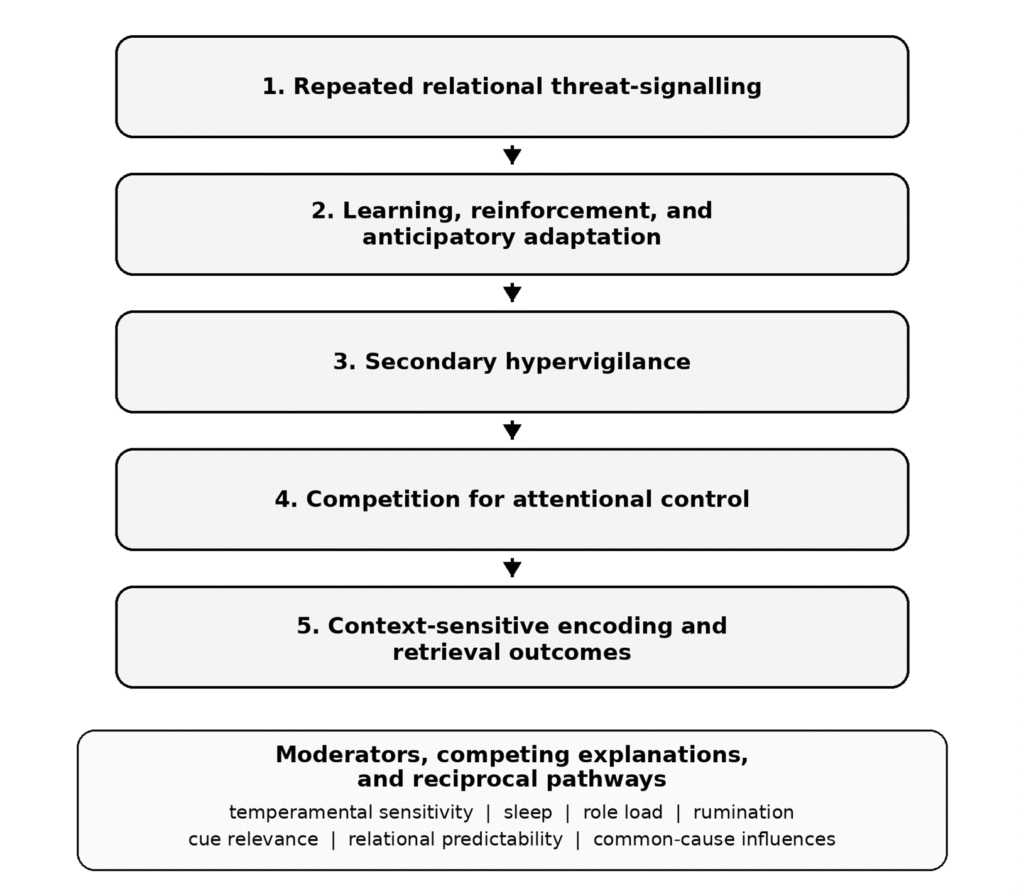
Note. Arrows represent hypotheses rather than established causation. Reciprocal influence, common-cause explanations, and non-relational sources of cognitive load remain possible.
Stage 1: Recurrent Relational Threat-Signalling
The sequence begins with recurrent cues that indicate possible danger, uncertainty, conflict, emotional escalation, or disruption. The cues need not be dramatic. Repetition may give predictive weight to subtle changes in voice, posture, movement, questioning, silence, or routine. The psychologically important feature is not the objective severity of each cue, but the learned expectation that early detection matters.
Stage 2: Learning, Reinforcement, and Anticipatory Adaptation
Monitoring is strengthened when it appears to reduce uncertainty or prevent an unwanted outcome. If noticing a cue allows the person to offer reassurance, avoid conflict, change plans, or prepare for a demand, the attentional shift may be negatively reinforced. The person learns that vigilance is useful because it reduces immediate discomfort. This learning can persist even when the original contingencies become less reliable.
Stage 3: Secondary Hypervigilance
Through repetition, monitoring becomes faster and less dependent on deliberate choice. The person may scan for interpersonal changes while reading, working, travelling, or carrying out household tasks. Secondary hypervigilance is therefore conceptualised as context-sensitive attentional preparedness. It may be strongest in the presence of a particular person, in locations associated with tension, or during periods of uncertainty.
Stage 4: Competition for Attentional Control
Automatic monitoring competes with the goal-directed system that maintains task rules, protects intentions, inhibits distraction, and updates working memory. The competition may not produce obvious failure on simple tasks. It is more likely to emerge under cognitive load, interruption, time pressure, emotional ambiguity, or divided responsibility. The person may compensate by checking, making lists, overpreparing, or increasing effort.
Stage 5: Context-Sensitive Memory Failure
The final stage is not necessarily loss of stored information. Weak encoding may leave little to retrieve; interrupted maintenance may cause an intention to drop from working memory; and heightened arousal at recall may temporarily reduce access. Recognition or later recall may remain intact, suggesting that information was available but difficult to access in the original context. The framework therefore predicts variability rather than a uniform deficit.
Falsifiable Hypotheses
Hypothesis 1. Greater exposure to recurrent interpersonal threat-signalling will predict stronger attention towards relational threat cues, even after individual trait anxiety and current mood are taken into account.
Hypothesis 2. The association between relational unpredictability and everyday cognitive failures will be statistically mediated by attentional capture, perceived monitoring responsibility, or reduced attentional control.
Hypothesis 3. Memory lapses will occur more frequently in contexts where the relevant family member is present, anticipated, or psychologically salient than in matched contexts with lower interpersonal-monitoring demands.
Hypothesis 4. Tasks requiring prospective remembering, sequencing, or updating will be more sensitive to relational monitoring than simple recognition tasks, because they depend more heavily on sustained attentional control.
Hypothesis 5. When information has been adequately encoded, supportive retrieval cues or delayed recall in a calmer context will recover more information than immediate free recall under interpersonal tension.
Hypothesis 6. Repeated experiences of predictability and non-escalation will reduce attention to relational threat cues and improve cognitive efficiency, even when conscious awareness of monitoring remains limited.
Hypothesis 7. The proposed pathway will add explanatory value beyond sleep quality, general distraction, role overload, rumination, and negative memory beliefs. If it does not, the relational construct should be revised or rejected.
Alternative Explanations and Boundary Conditions
A rigorous framework must remain vulnerable to simpler explanations. Family-linked forgetting may reflect interruptions, multitasking, insufficient sleep, role overload, persistent worry, low motivation, conflict, or a general attentional style that appears across settings. A person may also remember adequately while judging performance harshly. Subjective memory difficulty can therefore increase without a corresponding reduction in objective performance.
Direction of influence is another concern. A person who frequently forgets may prompt another family member to check, remind, or anticipate problems, thereby increasing the appearance of relational monitoring. Both people may also be responding to the same uncertainty rather than directly influencing one another. Longitudinal and moment-to-moment data are needed to distinguish these possibilities.
The concept should not be inferred from behavioural similarity alone. Similar vigilance can arise from shared circumstances, common routines, comparable temperament, or independent learning. Nor should low reported distress be treated as proof of hidden monitoring. The relevant variables – attention, perceived responsibility, contextual cueing, and cognitive performance – must be measured rather than assumed.
The framework also predicts boundary conditions. Little or no relation-specific effect should appear when the relational cues are predictable, when perceived responsibility is low, when the task is highly overlearned, or when strong external prompts protect the intention. A stable impairment across contexts, tasks, and relationships would weigh against a specifically relational attentional account.
Implications for Psychological Formulation and Support
Assessment and Context Comparison
A useful assessment begins with the pattern of lapses rather than a global statement that memory is poor. Relevant questions include what is forgotten, whether the information was noticed at the time, whether the lapse concerns an intention or a past event, what cues restore recall, and whether recognition is stronger than free recall. The assessor should also explore when the lapses occur, who is present, what the person is monitoring, and how much interruption or responsibility is active.
Context comparison is central. Performance when alone can be compared with performance during relational tension, anticipated contact, or active caregiving. Calm and high-load periods can be contrasted. The person’s confidence can be compared with objective task completion. A pattern that changes sharply across contexts would support an attentional formulation more strongly than a stable, context-independent pattern.
Formulation should remain collaborative and non-blaming. The purpose is not to identify a family member as the cause of another person’s cognitive difficulty. Monitoring may have developed as an intelligent attempt to preserve safety, predictability, connection, or harmony. The question is whether a once-useful adaptation now consumes attention in situations where it is no longer needed.
Reducing Monitoring Demand
Because secondary hypervigilance is proposed as partly automatic, coping cannot depend entirely on noticing every attentional shift. Psychological change can instead alter the conditions that maintain the pattern. Increased predictability, clearer boundaries, reduced role ambiguity, and protected periods of uninterrupted attention may lower the need for continuous monitoring. External supports such as written intentions, visible task cues, and single-task routines can protect memory while attentional habits are changing.
Attention can also be retrained through repeated practice in orienting towards task-relevant information and allowing non-urgent interpersonal cues to remain in the background. The aim is not suppression of awareness, but greater flexibility: the capacity to notice a cue without automatically abandoning the current goal. Brief grounding, paced breathing, attentional anchoring, and deliberate task re-entry after interruption may assist this transition when used as learning practices rather than emergency rituals.
Relational work may focus on reducing reassurance cycles, clarifying responsibility, and developing communication that does not require constant inference. Predictable signals can replace ambiguous monitoring. For example, family members may agree how genuine urgency will be communicated, thereby reducing the need to interpret every subtle change. Repeated experiences in which the person remains engaged with a task and no escalation follows may gradually update the expectation that constant preparedness is necessary.
Memory-specific strategies remain useful, but their purpose should be precise. Lists, alarms, consistent object locations, implementation intentions, and verbal rehearsal help compensate for prospective memory demands. They do not by themselves alter the attentional learning that produced the difficulty. A coherent approach therefore combines immediate cognitive support with longer-term changes in attentional flexibility and relational predictability.
These principles are formulation-level implications rather than evidence for a specific intervention protocol. Their value should be evaluated through measurable changes in attentional allocation, task performance, confidence, and everyday functioning rather than inferred from subjective plausibility alone.
Research Agenda
Longitudinal and Dyadic Designs
The strongest test would follow both members of a close family relationship over time. Measures should include trait anxiety, perceived relational unpredictability, observed threat-signalling, attention to interpersonal cues, attentional control, working memory, prospective memory, subjective cognitive failures, sleep, rumination, and role load. Repeated measurement would allow researchers to examine temporal order and reciprocal influence rather than assuming one-way transmission.
Experimental Separation of Encoding and Retrieval
Laboratory studies should distinguish whether relational cues interfere with initial encoding, temporary maintenance, or later retrieval. Participants could complete neutral memory tasks after exposure to threatening, ambiguous, and reassuring interpersonal signals. Recognition, cued recall, free recall, and prospective-memory performance should be measured separately. The framework predicts that relational monitoring will have its clearest effect on tasks requiring active maintenance and self-initiated retrieval.
Measurement of Attention
Reliance on a single reaction-time index would be insufficient. Eye tracking, visual search, behavioural observation, experience sampling, and task-linked subjective arousal could provide converging evidence. Researchers should assess initial orienting, dwell time, disengagement, and later avoidance separately. The interpersonal relevance of stimuli should also be established for each participant, rather than assumed based on generic threatening images or words.
Everyday-Life Sampling
Experience-sampling methods could examine whether lapses cluster around moments of perceived interpersonal responsibility, anticipated conflict, or emotional change. Brief prompts delivered across the day could record current attentional focus, relational context, cognitive load, intention maintenance, and recent forgetting. This approach would test whether laboratory mechanisms travel into ordinary life.
Change-Based Tests
A compelling test would examine whether reducing relational unpredictability changes attention and memory. Interventions could introduce clear signals of urgency, protected task periods, reduced reassurance cycles, and repeated experiences of safe, non-monitoring. Changes in attentional allocation should mediate improvements in memory if the proposed mechanism is correct. Improvement without attentional change would suggest another pathway.
Construct Validation
Before the term secondary hypervigilance can carry explanatory weight, researchers should develop measures that distinguish it from general threat sensitivity, caregiving burden, interpersonal sensitivity, rumination, and ordinary distraction. Validation should include test–retest reliability, convergent and discriminant validity, ecological prediction, and incremental prediction beyond established constructs. Multi-method assessment is essential because self-report alone may reflect appraisal as much as attention.
Limitations
The framework integrates adjacent research areas rather than reporting a direct test. Social learning, attentional bias, hypervigilance, working memory, stress, and everyday cognitive failure are overlapping but distinct constructs. Evidence drawn from developmental settings cannot automatically be generalised to adult family relationships. Acute laboratory stress also differs from chronic, fluctuating interpersonal uncertainty.
Measurement remains a central difficulty. Attentional-bias tasks can show limited reliability, self-reported memory may reflect negative appraisal as well as performance, and family members may differ in their interpretation of the same event. Group-level associations cannot establish an individual pathway. The construct of secondary hypervigilance will be useful only if it can be defined operationally and shown to predict outcomes beyond those explained by established variables.
The framework also risks retrospective storytelling. Once a memory difficulty and a tense family environment are known, it is easy to connect them after the fact. The theory must therefore generate prospective predictions, specify conditions under which the effect should not occur, and permit rejection. Where general distraction, sleep, or role overload explains the pattern equally well, the more complex relational explanation should not be preferred.
The literature reviewed here is heterogeneous in age, task, context, and measurement quality. Much of the relational evidence concerns parent–child development, whereas the proposed framework may also be relevant to adult family relationships. That extension is an inference and must not be assumed. The current article is a conceptual synthesis, not a systematic review, a meta-analysis, a diagnostic framework, or a validation study.
Conclusion
Psychological research supports each broad component of the proposed account: emotional meaning can be learned through close relationships; attention can become biased towards threat; anxiety can reduce the efficiency of attentional control and working memory; and stress can alter memory according to timing and context. These findings suggest that repeated adaptation to a threat-focused family environment may create automatic interpersonal monitoring that competes with ordinary cognition.
The complete pathway remains uncertain, so the framework is best treated as a testable psychological formulation. Apparent forgetting may sometimes arise not because memory has vanished, but because attention has been recruited elsewhere. Future research must trace that recruitment across relationships, situations, and phases of remembering.
Statements and Declarations
Funding: No external funding was received for the preparation of this manuscript.
Conflict of interest: The author declares no conflict of interest.
Data availability: No new data were created or analysed. Data availability is therefore not applicable.
Ethics statement: This article presents a conceptual synthesis and does not report research involving human participants or animals. Ethical approval and informed consent were therefore not required.
Author contribution: Jakub Tencl was responsible for conceptualisation, literature integration, framework development, writing, and revision of the manuscript.
Peer-review status: This manuscript is a preprint and has not undergone formal peer review.
Version statement: Version 1.0, July 2026. Later repository versions should be identified separately to keep changes traceable.
Suggested Citation
Tencl, J. (2026). Secondary hypervigilance, attentional allocation, and everyday memory: An evidence-informed conceptual framework (Version 1.0) [Preprint].
References
Aktar, E. (2022). Intergenerational transmission of anxious information processing biases: An updated conceptual model. Clinical Child and Family Psychology Review, 25(1), 182–203. https://doi.org/10.1007/s10567-022-00390-8
Aktar, E., Van Bockstaele, B., Pérez-Edgar, K., Wiers, R. W., & Bögels, S. M. (2019). Intergenerational transmission of attentional bias and anxiety. Developmental Science, 22(3), Article e12772. https://doi.org/10.1111/desc.12772
Bar-Haim, Y., Lamy, D., Pergamin, L., Bakermans-Kranenburg, M. J., & van IJzendoorn, M. H. (2007). Threat-related attentional bias in anxious and nonanxious individuals: A meta-analytic study. Psychological Bulletin, 133(1), 1–24. https://doi.org/10.1037/0033-2909.133.1.1
Craik, F. I. M., Govoni, R., Naveh-Benjamin, M., & Anderson, N. D. (1996). The effects of divided attention on encoding and retrieval processes in human memory. Journal of Experimental Psychology: General, 125(2), 159–180. https://doi.org/10.1037/0096-3445.125.2.159
de Rosnay, M., Cooper, P. J., Tsigaras, N., & Murray, L. (2006). Transmission of social anxiety from mother to infant: An experimental study using a social referencing paradigm. Behaviour Research and Therapy, 44(8), 1165–1175. https://doi.org/10.1016/j.brat.2005.09.003
Dudeney, J., Sharpe, L., & Hunt, C. (2015). Attentional bias towards threatening stimuli in children with anxiety: A meta-analysis. Clinical Psychology Review, 40, 66–75. https://doi.org/10.1016/j.cpr.2015.05.007
Dunne, G., & Askew, C. (2013). Vicarious learning and unlearning of fear in childhood via mother and stranger models. Emotion, 13(5), 974–980. https://doi.org/10.1037/a0032994
Emerson, L.-M., Ogielda, C., & Rowse, G. (2019). A systematic review of the role of parents in the development of anxious cognitions in children. Journal of Anxiety Disorders, 62, 15–25. https://doi.org/10.1016/j.janxdis.2018.11.002
Eysenck, M. W., Derakshan, N., Santos, R., & Calvo, M. G. (2007). Anxiety and cognitive performance: Attentional control theory. Emotion, 7(2), 336–353. https://doi.org/10.1037/1528-3542.7.2.336
Goodhew, S. C., & Edwards, M. (2024). Elevated cognitive failures in trait anxiety. Personality and Individual Differences, 216, Article 112418. https://doi.org/10.1016/j.paid.2023.112418
Legrand, L. N., McGue, M., & Iacono, W. G. (1999). A twin study of state and trait anxiety in childhood and adolescence. Journal of Child Psychology and Psychiatry, 40(6), 953–958. https://doi.org/10.1111/1469-7610.00512
Lin, Q., Wu, J., & Shen, Z. (2025). Intergenerational transmission of trait anxiety: Insights from different parenting styles using the actor–partner interdependence model. Acta Psychologica, 254, Article 104838. https://doi.org/10.1016/j.actpsy.2025.104838
McDaniel, M. A., & Einstein, G. O. (2000). Strategic and automatic processes in prospective memory retrieval: A multiprocess framework. Applied Cognitive Psychology, 14(Special Issue), S127–S144. https://doi.org/10.1002/acp.775
McLeod, B. D., Wood, J. J., & Weisz, J. R. (2007). Examining the association between parenting and childhood anxiety: A meta-analysis. Clinical Psychology Review, 27(2), 155–172. https://doi.org/10.1016/j.cpr.2006.09.002
Moran, T. P. (2016). Anxiety and working memory capacity: A meta-analysis and narrative review. Psychological Bulletin, 142(8), 831–864. https://doi.org/10.1037/bul0000051
Remmerswaal, D., Muris, P., & Huijding, J. (2016). Transmission of cognitive bias and fear from parents to children: An experimental study. Journal of Clinical Child & Adolescent Psychology, 45(5), 642–654. https://doi.org/10.1080/15374416.2014.987378
Schwabe, L., Joëls, M., Roozendaal, B., Wolf, O. T., & Oitzl, M. S. (2012). Stress effects on memory: An update and integration. Neuroscience & Biobehavioral Reviews, 36(7), 1740–1749. https://doi.org/10.1016/j.neubiorev.2011.07.002
Shields, G. S., Sazma, M. A., McCullough, A. M., & Yonelinas, A. P. (2017). The effects of acute stress on episodic memory: A meta-analysis and integrative review. Psychological Bulletin, 143(6), 636–675. https://doi.org/10.1037/bul0000100
Unsworth, N., McMillan, B. D., Brewer, G. A., & Spillers, G. J. (2012). Everyday attention failures: An individual differences investigation. Journal of Experimental Psychology: Learning, Memory, and Cognition, 38(6), 1765–1772. https://doi.org/10.1037/a0028075
